
Kakapos: The Tubbiest, (Not-so) Little Bird You’ve Ever Seen
Howdy again! Today we’re going to talk about the world’s largest, flightless parrot. I’m sure many of you didn’t even know there was such a thing, because I sure as hell didn’t. The kakapo or the Strigops habroptila [1] is also known as the Owl parrot and is indigenous to New Zealand. Currently, this fancy parrot is on the IUCN’s red list, which means it is “Critically Endangered”. This is an improvement from before, as in 1996 the bird was officially labeled as “Extinct in the Wild”.
The Kakapo – which is oddly also nocturnal – is primarily a vegetarian who breeds every 2-5 years. The mating season lasts for 3 months from January to March, with male birds calling to the females each night. Interestingly, the male’s call is a low frequency boom, that can travel several kilometers! [2] (If you’d like the hear it: you can do so here [3]). Once the eggs are laid, in batches of 1-4 eggs, the female attends to the eggs and eventually chicks. Shockingly, though the females take 6-11 years to mature, the birds can live up to 90 years! [1]

Nest containing 2 eggs and a new-born chick

This is Manu! In this picture, he’s 18 days old.

Look at Manu growing up! He’s 75 days old.

This is Alice. She’s feeding her 12-day old chick!

Alice’s baby is growing fast! He’s 45 days old now.
There is some speculation that the Owl Parrot is the longest-living species of bird, and originally used to be the size of a present day parrot (and used to be able to fly). However, New Zealand, the bird’s natural habitat – did not have mammals for thousands of years and thus the bird evolved to gain significant weight, lose its ability to fly, and actually became and avid hiker! [2] The Kakapo thus, used to be abundant throughout all of New Zealand without any real predators around, but after human colonization in the area, the population dropped to 18 male birds in 1976. By some small miracle, 150 additional birds were found in 1977 on a different island, which by 1988 had dropped to 61 birds. These remaining birds were transferred to different islands and in 1999, a recovery breeding program began with 50 individuals out of a population of 26 females and 36 males. From 2005 to 2009, the population increased from 86 to 114. Population numbers have been on a slow rise since then under heavy micromanagement. [1]
If you’d like to get involved and help out this (not-so) little guy, or just learn more about him, you can go to the Kakapo Recovery Program here [4].
I also highly recommend this video by “Mission Kakapo Copulation” available here [5] or here [6].
Remember, if you haven comments or questions, you can reach us at OpinionsOfANewAgeStudent@gmail.com, or at our twitter and tumblr @newagestudent.
Otherwise, I hope everyone enjoyed this adorable article and look forward to more!
Sources:
- http://www.iucnredlist.org/details/22685245/0
- http://kakaporecovery.org.nz/about-kakapo/
- http://kakaporecovery.org.nz/wp-content/uploads/2013/07/bill-boom-1.mp3
- http://kakaporecovery.org.nz/get-involved/
- http://channel.tepapa.govt.nz/video/mission-kakapo-copulation/
- https://youtu.be/RRSH6XeT5co
- http://nzbirdsonline.org.nz/species/kakapo ALL PHOTOS ARE FROM HERE
Advice: Virgin Guilt
Hi everyone! It’s been a while and a very, VERY busy few months. There will be a startling announcement coming out sometime in June (hopefully), so I hope you guys are ready for that!
In the mean time, we have our first user-submitted advice column! If you have questions or need advice of your own, you can always email us at opinonsofanewagestudent@gmail.com. In the mean time, let us commence!
Q: “I know virginity is a social construct, but I lost mine to someone I regret losing it to. It’s been years but it still bothers me. How do I move past this experience?”
RB: First of all, let me begin with this – in life, there are always going to be things people tell you are right and wrong. The thing is, what is right for someone, may be wrong for someone else. Furthermore, virginity is absolutely a social construct. Although we make it seem like the person you lose your virginity to is incredibly important and you shouldn’t do it unless you are madly in love and dedicated to that person, quite honestly, not only is that not true or fair, but frankly, it’s not healthy. I’m not saying that you should start sleeping around the second you hit puberty, but if you feel like you want to have sex and you are comfortable with the person you’re doing it with, then by all means, you should. I know plenty of people who have waited until their mid to late 20s and I know an equal amount of people who lost their virginity in high school. Society has this weird rule that the second you turn 18, you should lose your virginity, but that’s not true. Those who waited until their late 20s, some of them mutually lost their virginity to their spouses while others were so overcome by the desire to just get the process over with, that they not only weren’t mature as adults, but also regretted the choice they made. The same thing can be said of those who lost their virginity in high school. In the end, these same people, years after the experience all agreed that it really didn’t matter who they lost their virginity to; it was just another aspect of life to move past.
Now let me tell you a personal story that exhibits this perfectly. My best friend lost her virginity when she was 19 to the first guy she was in a serious relationship with. This guy was significantly older than her, but also a virgin and pressured her into having sex. She conceded, but the relationship became toxic to the point that I remember her crying everyday because of some sort of emotional or mental abuse. In the end, they broke up but she kept telling me that she wished she hadn’t made such a stupid decision and had thought it out more. However, what was done was done, and although I told her to move past it and just look forward to a wonderful future with someone amazing she would find one day, that advice is easier said than done. Fast forward several years and she finally was stable(ish) enough to start dating again. She met this guy who was absolutely amazing and perfect for her. It turns out, he had the EXACT same baggage that she did and also had regret. This mutually terrible experience for both of them ended up turning into a huge bonding experience. They were able to relate to and support each other unlike most people around them. Today, this couple is engaged and soon to be married, and they tell me that their life experiences that were terrible at the time, actually turned into positives because they may not have ended up together without those experiences.
TLDR; I’m a strong believer in karma. If you’re a good person, and something bad happens to you, it might turn into a great lesson and experience in the end. It might just take some time to realize that. Once you do, you’ll be able to look forward to the future, knowing that something good will happen out of a terrible experience.
alwaysinspyred: If it weren’t for the staggering societal implications of virginity, moving past ‘losing your virginity’ wouldn’t be any harder to ‘move past’ than outgrowing your favorite pair of underwear or graduating high school; unfortunately, due to the great taboo of sexuality in U.S. culture (assuming you’re from the United States), virginity is drilled into the social consciousness as being this extremely significant thing (like the myth that female genitalia have some physical distinction between virgin and non-virgin). The truth is, once you break away from the idea that virginity is an essential aspect of your sexual identity or integrity, there’s really nothing holding it up anymore. Your sexual experience (or lack thereof) doesn’t EVER need to be discretely marked or placed on any kind of ‘experience’ or ‘purity’ scale. Sexuality is one of the most intensely personal and unique aspects of the human experience.
Having said all of that, as social creatures, we humans naturally use others (usually close friends/family) as reference points for judging whether or not we are making the right choices, especially for new experiences, which is why guilt about one’s sexual past is, in my experience, VERY common, in no small part because of the aforementioned stigmas. I can’t really offer advice any more unique to your situation, I do hope that this advice has helped. I firmly believe that anyone whose image of you is negatively affected by the way you lost your virginity simply has an immature sense of sexuality. I hope you can find peace from your experience and use it to help you grow.
TBI and Degenerative Brain diseases: What are they?
Hi everyone! So just a bit of a heads up, the format we’re going to be following in the next several articles is going to be a bit different. Each article is going to be a about a specific aspect of health and will eventually all culminate in how all these aspects relate to a specific medical condition. It’s important to me that these articles all be stand-alone for future reference, so the articles will be fairly broad to start off on, with definitions for many terms as footnotes. If you have further questions, you can always comment, OR Google is your friend. That being said, let’s begin! This first part in the series is about what are the commonalities about Traumatic Brain Injuries (TBI) and Degenerative Brian Diseases (DBD) and what’s happening to your brain while this is going on.
These days, the more violent the sport, the more popular it’s becoming. Activities like MMA, UFC, kickboxing, and football are everywhere you look. But there’s something else in common with all of these activities – TBI. There’s currently a plethora of studies and attention being brought to this issue due to the release of movies like “Concussion”, and the general attention brought to the danger of football. Here’s the catch – a lot of the symptoms of TBI mirror those of DBDs, like Alzheimer’s and Parkinson’s.
So what exactly happens with a TBI? When you get hit in the head too much, or really at all, the brain takes on mechanical damage, injuring its tissues, and also increases blood flow to the area. This leads to a chain reaction of feedback in the brain. The first is the accumulation of lactic acid due to anaerobic glycolysis¹. The ATP stores become depleted and this leads to a breakdown of the ion pumps in the brain. Simultaneously, increased membrane permeability, or the damaging the protective tissues around the brain is taking place. This causes the blood-brain barrier to become “leaky”, which causes molecules like potassium and chlorine as well as neurotransmitters like glutamate and aspartate to flood the brain. At the same time, the calcium-sodium pumps, which became dysfunctional during the first steps, become imbalanced and the combination of all of these reactions leads to a depolarization in the system, which causes swelling in the brain. Simultaneously, the immune system in the body kicks in when the tissue in the brain is damaged, and micro-gleal¹ cells are activated and migrate to “plug up the holes” in the brain membrane. This is what causes the swelling in the brain. This swelling, can eventually lead to an edema² – the third step. When an edema forms, the extra calcium ions lead to an increased concentration of free radicals and fatty acids. The structure of the biological membranes and the nucleosomal DNA also changes. During this same process, the micro-gleal cells are trying to eat cellular debris that occurred during the damage and this causes neural-inflammation. These three steps together lead to the degradation of the membrane and ultimately, programmed cell death, a reaction the body has to destroy potentially pre-cancerous cells. All of this happens within a few hours of the initial injury. What we end up with as the final product is the accumulation of Amaloyd-Beta Plaques (ABPs). (1 and 2)

fighter with cerebral edema

Normal Brain vs. Alzheimer’s Brain PET Scan

Normal Brain vs. Alzheimer’s Brains

Process by which dementia takes place
And finally, what is Parkinson’s? Parkinson’s is a progressive neurodegenerative disease, which inhibits overall movement, due to the death of nerve cells. Parkinson’s mainly affects dopamine in cells in the part of the brain called the “substantia nigra”³, whose dying neurons produce less and less dopamine as the disease progresses. Furthermore, the presence of alpha-synuclein proteins, or Lewy bodies, in the mid-brain, brain stem and olfactory bulb are also indicative of Parkinson’s. There are 4 main indicators of Parkinson’s: tremor of the hands, arms, legs, jaw and face, bradykinesia or slowness of movement, rigidity or stiffness of the limbs and trunk, and postural instability or impaired balance and coordination. (5) There, however, is another type of Parkinson’s known as Parkinsonism. It is a disease that exhibit the 4 symptoms of Parkinson’s, but is not Parkinson’s. According to www.atrainceu.com,
“Parkinsonism often has an identifiable cause, such as exposure to toxins, methamphetamine, trauma, multiple strokes, other nervous system disorders, or illness. Generally, Lewy bodies are not seen in parkinsonism. The term parkinsonism is also associated with disorders such as progressive supranuclear palsy, multiple system atrophy, Lewy body dementia, corticobasal degeneration, vascular parkinsonism, drug-induced parkinsonism, and parkinsonism secondary to infection and other causes (Hohler et al., 2012)”
Interestingly, methamphetamine users often have Parkinsonism and are at a higher likelihood to develop Parkinson’s. Now, the exact pathopsychology of Parkinson’s is not completely known. What we do know is that several factors cause Parkinson’s. First off is the most commonly known reason – the lack of dopamine. Dopamine is secreted into the synapse, crosses the synapse, and activates dopamine receptors. Unused dopamine is absorbed back into the presynaptic membrane, to be released next time. However, as an individual ages, they produce less and less dopamine. This lack of dopamine results in cell death. However, in Parkinson’s this process is accelerated. The decrease of dopamine also causes an eventual decrease in the production of glutamate, GABA, and serotonin. Dopamine decrease is not the only indicator of Parkinson’s however. As aforementioned, Lewy bodies are also present in Parkinson’s patients. Lewy bodies are an cluster of misfolded proteins that abnormally form within the neuron. How these proteins are related to Parkinson’s however, is uncertain. (6) As for Parkinsonism, the pathopsychology is unclear.
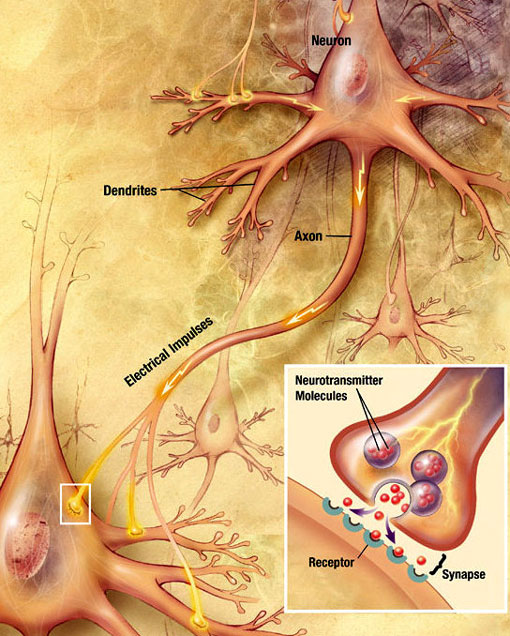
How dopamine travels through the neuron

Dopamine levels in a normal person vs. Parkinson’s patient

Dopamine levels in normal individuals vs. Parkinson’s patients

PET Scan of Normal Brain vs. Parkinson’s Brain
So what do all these disease have in common? If you’ll notice, all of the diseases end up with the production of ABPs. According to http://www.atrainceu.com
“Neurodegenerative disorders such as Alzheimer’s disease, frontal-temporal degeneration, prion disease, Huntington’s chorea, and motoneuron diseases are increasingly being realized to have common cellular and molecular mechanisms, including protein aggregation and inclusion body formation in certain areas of the nervous system.”
Essentially, the breakdown comes to this: When the brain experiences any kind of “stress”, whether that be external or internal, it begins to create ABPs. The creation of ABPs leads to a negative feedback cycle of more ABPs being created, and eventually, cell death in the brain. When brain cells are stressed, they release a protein that tells them to die. Sometimes, they don’t die immediately, but the more times they are stressed over time, the more “death targeting” proteins they release. This makes the cells more susceptible to death, eventually killing off large groups of cells that have undergone repeated stress. This process predisposes individuals to neurodegenerative diseases. TBIs and DBDs all have this in common: a large amount of ABPs and Tao proteins coming together to inflame parts of the brain. The only reason many exclude Alzheimer’s from the neurodegenerative diseases is because it is specifically age related, though as previously discussed, TBIs can affect the time-span in which you get a DBD. (1) Long story short, there’s still a lot to learn about DBDs and TBIs, but inflammation is generally bad. Be ready to learn more in the next article!
Footnotes:
- Anaerobic respiration is the process of producing cellular energy without oxygen. Anaerobic respiration is a relatively fast reaction and produces 2 ATP, which is far fewer than aerobic respiration.

Anaerobic and Aerobic respiration
- Microglia are a type of glial cell that are the resident macrophages of the brain and spinal cord, and thus act as the first and main form of active immune defense in the central nervous system (CNS). Microglia constitute 10–15% of all cells found within the brain
- An Edema is a condition characterized by an excess of watery fluid collecting in the cavities or tissues of the body.
- Substantia nigra is a brain structure located in the mesencephalon (midbrain) that plays an important role in reward, addiction, and movement.

Substantia nigra in Normal brain vs. Parkinson’s brain
Sources:
- Joe Rogan interview with Rhonda Patrick: http://podcasts.joerogan.net/podcasts/dr-rhonda-patrick-3
- http://bja.oxfordjournals.org/content/99/1/4.full
- Lectures by Enrique Cadenas
- Science Friday: http://www.sciencefriday.com/segments/always-hungry-your-fat-cells-may-be-to-blame/
- http://www.pdf.org/about_pd
- https://www.atrainceu.com/course-module/2441043-143_parkinsons-module-02
- http://www.traumaticbraininjury.com
- http://www.mayoclinic.org/diseases-conditions/traumatic-brain-injury/basics/symptoms/con-20029302
- http://www.cdc.gov/traumaticbraininjury/get_the_facts.html
- http://www.apdaparkinson.org/parkinsons-disease/understanding-the-basics/
- http://www.clevelandclinicmeded.com/medicalpubs/diseasemanagement/neurology/parkinsons-disease/
- http://www.ncbi.nlm.nih.gov/pmc/articles/PMC2467461/
For the Good of the Party
I’ll get straight to the point: this article is about the U.S. Presidential Primary process, especially in the context of the 2016 New Hampshire Democratic Primary Election that took place on February 9th, 2016. As much as I’m tempted to delve into the actual politics of the event, what I want to discuss here is the role of the electoral system in this context.
There does seem to be a general, if not common, perception that the mechanics of primary presidential elections necessarily reflect the premises of the democratic system of the U.S.; this is mostly true, but it also has a moderate mix of the premises of privatization. Horray for the privatization of the political process! And what’s more: this is all actually quite new! Superdelegates weren’t introduced into the electoral system until after 1968 (Source)
But they really haven’t been too relevant in the political process until the 1984 election in particular (Source), and then
Check out the Twelfth Amendment of the U.S. Constitution (Source)
The Electors shall meet in their respective states, and vote by ballot for President and Vice-President, one of whom, at least, shall not be an inhabitant of the same state with themselves; they shall name in their ballots the person voted for as President, and in distinct ballots the person voted for as Vice-President, and they shall make distinct lists of all persons voted for as President, and of all persons voted for as Vice-President, and of the number of votes for each, which lists they shall sign and certify, and transmit sealed to the seat of the government of the United States, directed to the President of the Senate; The President of the Senate shall, in the presence of the Senate and House of Representatives, open all the certificates and the votes shall then be counted;–The person having the greatest number of votes for President, shall be the President, if such number be a majority of the whole number of Electors appointed; and if no person have such majority, then from the persons having the highest numbers not exceeding three on the list of those voted for as President, the House of Representatives shall choose immediately, by ballot, the President. But in choosing the President, the votes shall be taken by states, the representation from each state having one vote; a quorum for this purpose shall consist of a member or members from two-thirds of the states, and a majority of all the states shall be necessary to a choice…. The person having the greatest number of votes as Vice-President, shall be the Vice-President, if such number be a majority of the whole number of Electors appointed, and if no person have a majority, then from the two highest numbers on the list, the Senate shall choose the Vice-President; a quorum for the purpose shall consist of two-thirds of the whole number of Senators, and a majority of the whole number shall be necessary to a choice. But no person constitutionally ineligible to the office of President shall be eligible to that of Vice-President to the United States.
And also, Article II, Section 1:
The executive Power shall be vested in a President of the United States of America. He shall hold his Office during the Term of four Years, and, together with the Vice President, chosen for the same Term, be elected, as follows
Each State shall appoint, in such Manner as the Legislature thereof may direct, a Number of Electors, equal to the whole Number of Senators and Representatives to which the State may be entitled in the Congress: but no Senator or Representative, or Person holding an Office of Trust or Profit under the United States, shall be appointed an Elector.
The Congress may determine the Time of choosing the Electors, and the Day on which they shall give their Votes; which Day shall be the same throughout the United States.
Parsing the speech is a bit tricky for me, but in terms of relevance to this article, I gathered this:
- Number of Delegates for a Given State = Number of Senators (2) + Number of House Representatives (variable by state).
- The state legislatures are responsible for their own delegate selection.
- The votes of the electors are the ones that are directly counted to determine the president.
- The Vice-President is supposed to be elected separately from President (I actually didn’t know this tidbit until researching this article)
So those “Presidential Tickets” with the President and VP bundled up together? That’s purely a construct of the political parties. It would be quite inconvenient for a president to have a VP that might be from the opposing party.
Now, I’ve heard MANY different renditions of how “voting is completely useless because the Electoral College is what decides the president and votes have no control over that”, but a closer look at the way electors are decided on a state-by-state basis reveals that electors are almost entirely beholden to the voters they are supposed to be representing.
The purpose for the Electoral College is clear in historical context: in the late 18th Century, information traveled much more slowly. While the postal service did enable more efficient communication than ever before, it still couldn’t be carried across large distances any faster than a horse’s gallop. The electoral college was designed to consolidate voting results and send them over to wherever the president was to cast their vote on behalf of the people they represent. Electors are pledged to vote for a certain candidate, though ‘Unpledged Electors’ were allowed up until the 1964 election, after which NO state has filed a slate for any unpledged electors, though these delegates were allowed to vote for any candidate they chose on election day, much like superdelegates… but I’ll get to that later.
In the past, there HAVE been ‘Faithless Electors’ who pledged to vote for a certain candidate, only to actually cast a vote for a different candidate. The most recent instance of a faithless elector was in Minnesota in 2004 (Source), and have never had a decisive impact on any presidential election. since the late 19th century.
So that’s the electoral college in a nutshell, and also why some states (like Maine and Nebraska for the first time in 2008) split their electoral votes, while others are all-or-nothing as far as how delegates are allocated for each presidential candidate.
But how does this relate to superdelegates?
Well, one important point that is worth bolding in text: the presidential primary system as we know it in the United States has absolutely zero explicit ties to the Constitutional electoral system. They’re similar and closely related, and the former is specifically designed to feed directly into the latter, but the primaries are not a part of the government; they are purely constructed by political parties.
The Democrats and Republicans have both designed their primary systems very deliberately similar to the Constitutional electoral system. After all, the whole point is for their nominee to head right into the actual presidential election, so the best way to prepare them for that race is to emulate it within their own. The primaries not only enable the party to narrow down exactly who they want running, but also allows them to probe for strategies in the national election; public reactions to primary debate questions can give hints on how a candidate might handle that issue in the general election.
Aside: I think the terminology for “general election” and “primary election” subtly suggests that the two are somehow two phases of the same process. That’s how the pattern has been, and ‘the way things work’ of course, but I want to really emphasize how the “primary election” is not even on the same plane of necessity as the “general election” in terms of how a president is elected.
So the parties have, instead of electors, delegates, which are invariably elected officials (usually from Congress) that are not only members of, but are very closely tied to, the political party. The individual delegates and even their numbers are decided by the parties on a state-by-state basis. Mind you, pretty much everything about this whole process is simply decided by the party, though they tend to prefer methods that don’t stray too far from Constitutional design and also keep them somewhat grounded in their constituencies. According to the Associated Press, the Democrats have 4,763 delegates and the Republicans have 2,472. These numbers (and their relative proportions of superdelegates) changes between elections. Mind you: the primary election is won by winning a majority of the delegates, regardless of how those delegates are distributed.
These superdelegates are unpledged: they don’t have to explicitly pledge to a candidate up until decision day. In fact, the 2008 Democratic Primary between Hillary Clinton and Barack Obama raised quite a few concerns about superdelegates; the election started with Hillary having more endorsements from superdelegates, but that shifted later in the primary process, presumably to match popular opinion. Indeed, the race was close enough that the superdelegates could have swung it. Ultimately, enough of them voted for Obama to win him the nomination. (Source)(Source)
Why the superdelegates? Well, remember, the political parties do their best to resemble the Constitutional system, but they are not a governmental entity. While the courts can act on the legality of their actions in the context of the constitution, political parties are not bound to do exactly what the people say… and doing so has bitten them in the past. The Superdelegates were introduced into the Democratic Primary system after 1968, when (Vice President at the time) Hubert Humphrey was nominated by the Democratic Party… and not by the primary votes. While the primary system was based on the Constitutional election system, it was, in practice, largely ceremonial. The Democratic National Convention, when convening to decide who to officially nominate for the Presidential race, were not bound to select whomever won the primaries… in fact, they didn’t even need to select a nominee from those who ran in the primaries. In 1968, Hubert Humphrey was selected as the Democratic nominee despite not having run in a single primary. The party’s leadership completely disregarded the will of the voters that was expressed in the primaries and selected one their influential leaders. The Democratic voters did not vote for Humphrey in the primaries and frankly felt betrayed by their own party leadership. Consequently, Humphrey was smashed by Nixon in the election, 301 to 191 electoral votes. (Source)
After that, the Democratic Party members decided they needed a way to prevent something like that from happening. The party’s nominees would necessarily need to reflect the desires of their constituency… though not entirely. The party leadership was not about to cede ALL power of nomination to the voters. Enter the Superdelegate.
So how are they relevant now? Well, the New Hampshire Democratic Primary on February 9th of 2015 between Bernie Sanders and Hillary Clinton (and also technically Martin O’Malley) yielded very interesting results from news sources.
Across the board, Bernie Sanders won the popular vote by a margin of over 20%.
Yet… many news agencies also reported a 15-15 split in delegates between Sanders and Clinton. Why? You guessed it: Superdelegates. They flocked to support Hillary.
This prompted quite a bit of backlash against the Democratic primary system, and in my mind, understandably so.
Here are some graphics on the state of two candidates shortly after the N.H. primary:
Disclaimer: While I also believe that CNN has a clear bias towards the establishment manifested in very selective reporting, I have yet to see them flat-out lie. They may neglect to show numbers that don’t support their preferred narrative, but I don’t think they’d outright lie about them.
Clinton:

Source: http://www.cnn.com/election/primaries/candidates/hillary-clinton as of 2/10/2016
Sanders:

Source: http://www.cnn.com/election/primaries/candidates/bernie-sanders as of 2/10/2016
Remember: pledged delegates are committed to the candidate their constituencies vote for immediately once the results are settled. Superdelegates can change their vote all the way up until decision day, so those numbers ARE subject to change, but regardless, the disparity is glaring.
Again, this article isn’t about supporting one candidate over another, but to draw attention to the sharp disparity between democratic ideals and reality. It can be easy to conflate the primary elections with the actual Constitutional electoral process. The parties are in it for themselves, and cater to their constituents at least as much as they need to in order to retain their votes. While they have yet to take any drastic strategic measures with Superdelegates, their effect on the election is palpable.
Unexpected Updates!
Hello All! So, I have some super exciting, quick news! We’re bringing on a new member to the team! I understand that this might be confusing as I’ve been using the word “we” for god knows how long… but now we will officially be a “we”! Our new author happens to be a very close, personal friend of mine! He’s brilliant and amazing and presents a very different perspective from me! I think this different perspective is actually incredibly important, because although the name of the blog is “The Opinions of a New Age Student”, there’s more than one kind of new age student. Our new Administrator takes a more meditative outlook than I do, which is super important to consider when looking at issues! At least in the beginning, most of his contributions will be in the political commentary spectrum and his first article is coming out hopefully within the week!
With that being said, make sure to stay on the look out, be excited, and make sure to follow us on Twitter @newagestudent and on Tumblr @newagestudent! You can also reach us at opinionsofanewagestudent@gmail.com or comment on the section below!
Otherwise, I’m very excited for this unexpected development and I hope you guys are too!
Sincerely,
RB
Expert Advice: If You’re Being a Jerk, Calm Down
Howdy all! I hope everyone had a wonderful holiday season and a wonderful year’s beginning! So while we’re in the middle of writing our mini-series, I don’t want you guys to get bored! So the solution?: Our first “Expert Advice” article! Here’s the thing, this article isn’t so much a traditional “Ask Amy” or an “If I Were You” (my preference) type article. More just an excuse to allow me to rant about something I’ve noticed that’s prevalent in society (I haven’t done one of these in a while!).
And I’m going to warn my audience and make a Dan Carlin-esque disclosure: I’m 100% going to offend literally everyone with some part of what I’m about to say. If demand is high enough, I’ll delve deeper into my individual topic opinions, but this article, as opposed to my usual style, is more stream of consciousness and a culmination of my overall personality. It isn’t going to focus on one topic and in fact, is going to jump around quite a bit. But, I think it’s INCREDIBLY important that when you see a fault in society, you point it out, in a kind and gentle way. Because at the end of the day, terrible things are going to happen. We can’t put all instances on the same plane of good and bad. But what matters is the person’s intention. Sometimes in life, I try my absolute hardest to help someone, and in the end, I end up messing everything up so badly that I wish I hadn’t done anything at all. But at the end of the day, I wasn’t trying to mess everything up; I was trying to help. And that’s what matters. And I want to make clear that that is what I’m trying to accomplish with this post. My goal is ultimately to make a more comfortable social atmosphere where ideas and perspectives can be exchanged, rather than starting a fighting match and having a preschool reminiscent argument of “No. MY opinion is better. You suck.” And what’s the point of having a blog if I don’t make use of it? So. You’ve been fairly warned. Enjoy the rest!
It’s become obvious to me that our society is becoming more and more liberal as time has been going on. Disregarding the current political atmosphere (I’m not even going to bother talking about what a cancer Trump is), we see that even the older folks who have been traditionally conservative are being swayed, or just passing away, to make room for the more liberally minded youth. However, this new liberalism is creating an equally disturbing atmosphere of “extreme liberalism” where everyone has to been politically correct all the time, jokes are not acceptable, and anyone who disagrees with your sentiment is a bigoted-fool who deserves ridicule. I’m going to be very clear on my stance: Nothing good has ever come from being on any extreme. I don’t care if you’re Hitler or Gandhi (either Indra or Mohandas), you’re equally bad in my book. The same applies to present day issues, whether it be abortion, video games, sexuality, sex, and yes, even rape. The only category I would argue is excluded from this is genocide or mass-murder. If you’re ok killing multiple people, whether it be ten or a thousand, you deserve to burn in hell. That’s a personality trait that is going to bleed into everything you do.
So, let’s roll back for a second. Did I just say rape? Am I saying rape is ok? Am I some sort of weird rape-apologist or even worse, a rapist? The answer: Hell no. No where close. Here’s what I am saying: Let’s say you have a pediatric neurosurgeon. This guy (or gal) has saved thousands of children’s lives. He’s part of Doctors Without Borders. He was in Zimbabwe saving children (on that note, Mugabe can rot in hell too). Started a non-profit that does pro-bono surgery for children in impoverished nations. Great guy, right? Maybe even deserves a Nobel prize? Here’s the thing: this guy is a serial rapist. Does that mean all the good he’s done in this world is discounted? No. He’s saved thousands of lives and no matter what you say, those children and their families are thankful. But does that mean he’s excused for his actions? Absolutely not. He gets to go to jail. He’s committed an atrocious, inexcusable crime and can rot in jail. Those aren’t contradicting statements. What I’m saying is the person is separate from their work. You can do AMAZING work, and still be the scum of the Earth. Whether you want to admit it or not, Hitler’s programs moved medical science forward by at LEAST a hundred years. Was it ethical or even right? No. But you can’t ignore facts because “You don’t like someone”. Statistically, almost everyone in the world has done something wrong, or something you might disagree with. But if you go with the theory that “If all my heroes are criminals, then I have no heroes”, well then you’re excluding yourself from some amazing life lessons. We don’t need to like every part of a person at all times. We just need to value certain aspects of them. You can love how great of a doctor the neurosurgeon was, love Gandhi’s dedication to his cause, and love Hitler’s charisma, and still hate all of them as people. But if you go against every aspect of everyone you dislike, you will never vicariously learn life lessons, and you won’t grow as a person.
So, at this point, some people might call me a terrible person or a rape apologist. Here’s what I have to say to them: Screw you. You have no idea what my life has been, what the hell I’ve been through, and my experience with domestic violence or sexual assault. And here’s the thing: I don’t owe you an explanation. My knowledge and opinion can not only be verified by me telling you my life story. I have been through my own personal hell, just like everyone else. And let’s say I didn’t have any personal experience – it doesn’t matter. My opinion is my own and I am entitled to it, just the same as everyone else. Can you imagine the trauma an individual has to face every time they have to recount their story, just to TRY and allow you to understand their opinion? Just think about it this way. You get into an argument with someone about the death penalty. You are adamantly for the death penalty and your opponent is adamantly against it. You both bring up several valid points but at the end of the day, you say “You don’t understand. You don’t know what you’re talking about. You’ve never had to deal with someone who’s life got taken away and you would change your mind if someone you knew was murdered.” Immediately, the other person breaks down crying and runs away. You have no idea why. It turns out, this person’s father was murdered by his best friend back in the 90s, and they saw it happen in front of them. That’s traumatic. And you brought it up completely inconsiderate of their backstory; not intentionally, but how could you have known. And that’s a perfect example of why we have to be sensitive when judging someone else. You might also be having a tough time with the conversation because of your own personal reasons. But if you only attack the other person, you’ll never figure out that you guys have a common experience or ally that you can bond you together and help you fight against the aspect you both wish to fight against. There’s no movement forward without cooperation. Only stagnation. And you might think that’s an incredibly rare situation and when does that happen. Well, right off the bat, I’ve been put into a similar situation multiple times, so don’t discount something just because you think it doesn’t happen. It happens a lot more than you think.
So let’s back up again. How do we fix this? You can’t just pre-monese someone’s life story. The answer: Be kind. Be understanding. Know that just because someone doesn’t agree with you, that doesn’t mean they don’t have their own reasons and own perspective. And even if they don’t, so what? If someone disagrees with you, you don’t get to say “you HAVE to do this, or else” or “because you feel this way, I’m going to do this to you”. By all means, if it bothers you so much, stop talking to them, unfriend them, don’t talk to them – as close-minded as that is, you’re welcome to your own opinions and actions. People will judge you on your actions. But, there is no way you get to tell other people to not talk to them or unfriend them, without repercussions. That’s abusive and frankly manipulative. Honestly, you’re a shitty person. But guess what? Just cause you’re a shitty person, it doesn’t discount all the good stuff you’ve done. Isn’t it funny how things come full circle?
And on that note, we as a society need to learn how to take a joke. Not everything in life is terrible and needs a fight. Note the person’s intent. And then maybe, we can all have a good laugh together. Honestly, that sounds really nice. Not everything has to be so PC. I think Chris Hardwick and Wil Wheaton described this sentiment best on Hardwick’s podcast “The Nerdist”. In reference to the Bill Cosby scandal, “It’s not like we’re saying ‘Let’s make Cosby jokes a lot!’ It’s in the news a lot and it’s at the forefront of comedians minds…But it comes from ‘You’re trying to make rape funny’. No. It’s the guy. He needs to be taken down. And a comedian can’t go punch in the face, so the only thing a comedian can do is punch him with jokes…we have to keep him down and shamed where he belongs” [1]. And it’s not just comedians who handle things that way. There’s a lot of people out there who have dealt with traumatic issues and express their anxiety or anger through joking. Just the same way that some people handle it through outburst or sporadic crying or even depression in some cases. But everyone handles their issues differently and by trying to stifle that because it doesn’t appeal to you, is factually damaging to another person’s mental state. Because the comedian’s purpose is by no means to attack or hurt anyone’s feelings, except for the person they’re making the joke about (i.e. Cosby, Hitler, etc.). And if the intention is pure, attacking that person is going back to essentially mentally and emotionally abusing this individual for dealing with their demons in their own way.
This ability to separate people from their work is part of what we call “being an adult”. We’re not in high school anymore, people (and if you are, you’re getting an early life lesson). The world isn’t going to get any better by everyone being assholes to each other. Listen to people. Work together. If you’re a Trump supporter, you’re not going to accomplish anything by throwing poor Sikh, Jewish, Muslim, and other minorities out of the rally. If you’re a feminist, shoving your propaganda in someone’s face isn’t going to help your cause. In both cases, you just make people resent you, and not look out for your best interest. I’ll adamantly agree that we need to fight against the normalization of negative behavior like rape/murder/sexism/etc., but a socially violent backlash against every joke, comment or perspective only succeeds in making that entire discussion more hostile for both sides, and no one leaves any happier or the wiser. By belittling someone’s opinion, you have put yourself in a situation where people are actively making a decision to not help you and maybe even stay away from you. And bless you if you have friends, that even though they feel threatened by you, they still stand up to help you out. But frankly, most people aren’t that nice. Which means sooner or later, history will repeat itself and those who take an extreme stance on anything will be marred by history, torn down, and the entire cause, no matter how just, will be tarnished by how you were perceived, and nothing to do with how amazing of a cause you might have.
Hopefully, this article has given you a different perspective to think about. Hopefully, if you’ve attacked people in the past on their opinion, you’ll man up and take a moment to apologize. I’m not saying I’m perfect by any means. I have some apologizing to do too. But, if we don’t all take a step forward together, we stay stagnant or worse, move back. And if this article did the complete opposite, and you hate me for it, that’s fine too. Feel free to unfriend me, hate me, talk shit about me to whoever you want. That’s 100% your right as an individual. But if that spills over into attacking others based on their opinion, just know that you are a toxic person. You are not contributing to society or your cause in any way. Simply making others see your cause with an associated negative light. But again, that’s your right as an individual. And even if you don’t care about the individual because “The cause is more important than any one person,” well that’s fine too. But it benefits you to approach the situation the same way because if you don’t, that associated negative light will eventually spread through not just people who know you, but through the entire cause as a whole, and at the very least, you care about the cause. The best examples of this are the current perception of “3rd-wave feminists” or PETA members, or even churches and religious institutions like the Westboro Baptist Church, that are just overall all seen as “full of crazy people.” You can’t tell me that reputation has helped any one of those organizations.
In essence, as long as you are kind and open-minded to the other individual, we can make progress in a many number of issues. But we will only remain stagnant as a society if we refuse to work together. So to sum it all up: if you’re being a jerk, calm down.
Sources:
- “http://nerdist.com/nerdist-podcast-wil-wheaton-returns-again/” ~48 minute mark.
Drastic Changes
Hello All! So you may have noticed some changes over the last couple of weeks. Most noticeably is that we have a completely new theme up! Hopefully you all like it! You may have also noticed that we have some new and unexpected categories being added to the mix! You’re going to want to keep an eye out for many new categories to come.
Also, we’re on Tumblr now! You can find us at: newagestudent.tumblr.com. If anything, you can’t say we aren’t consistent with our usernames.
And finally, an announcement! We’re currently in the progress or writing and releasing a series of articles. These are going to medically and scientifically related articles that are all going to culminate into a huge conclusion piece, so make sure to keep your eyes out for that as well! In the mean time, I hope you continue to enjoy the site and the changes to come!
Make sure to follow us on Twitter at @newagestudent and on Tumblr @newagestudent to like and comment on posts! Feel free to refer us as well!
Happy Holidays everyone!
Love,
RB
Baked History: The Courting Cake
So today’s going to be a quickie! We’re going to talk about the history of the oh-so-delicious “Courting Cake.” The Courting Cake originated in Lancshire, England as a gift from women to the men they fancied. During this time in British history, men and women were usually segregated as the men did hard manual labor and women worked in cotton mills and lighter industry. This meant there wasn’t a lot of cross over between when men and women COULD meet, so a specific “promenade” area was set up when men and women could interact. Usually, this was done by walking up and down the street with your friends until a member of the opposite sex caught your eye. Some places like Preston segregated the prospective lovers even more with office clerks and similar ranks were on one street, and factory workers and those equivalent ranks were on another street. Either ways, at the end of the day, if someone caught your fancy, they would eventually be presented with a Courting Cake!
The ingredients themselves represent important aspects of the woman as well, all the more to win over the heart of her lover! The recipe uses shortbread as a base, which is like a thicker version of a sponge cake. A shortbread is slightly more difficult to make, so this would expect the wife-to-be’s baking skills! The recipe also uses strawberries, though in the days of yore, they used over-ripe or slightly bruised strawberries to represent “many a woman’s heart, slightly bruised, battered, and oft’ times a little past their best by the time they become betrothed” [1].
However, this adorable tradition eventually spread, all through England and even to the states! The most famous incident of the is the Lincoln couple. Apparently, in an effort to win Abraham Lincoln’s heart, Mary Todd went out and bought a recipe for Courting Cake. Upon tasting it, Lincoln proclaimed it was the best cake he had ever had [2]. Eventually, this recipe became a regular baking tradition at the Lincoln household. Even Prince William and Princess Kate Middleton were presented with a courting cake on their wedding day [1].
Now I’m sure you all are craving this cake now and wondering just exactly how to make it! Well, my loyal readers, below I have listed the recipe for your hearts to consume with joy. The recipe, as a side note, comes from one of my favorite shows, “The Great British Bake-Off”! So, I hope you all enjoy and enjoyed this delicious historical tid-bit.
Makes about 16 slices
225g/8 oz Butter or sunflower margarine
225g/8 oz Caster or granulated sugar
4 Free-range eggs, lightly beaten
350g/12 oz Self-raising flour
30-45ml/2-3 tbsp Full-fat milk
300ml/10 fl oz Double cream
225g/8 oz Strawberries, sliced
Icing sugar, to decorate
1. Grease and line the bases of three 18 cm (7 inch) round cake tins.
2. Cream the butter and the sugar together until pale and fluffy. Gradually add the eggs, a little at a time, beating well after each addition. Fold in the flour, then add enough milk to give a soft dropping consistency.
3. Divide the mixture evenly between the prepared tins and bake at 180c, gas mark 4, for 25 – 30 minutes, until well risen and firm to the touch, swapping the position of the top and bottom cakes halfway through cooking. Turn out and leave to cool on a wire rack.
4. Whip the cream until it just holds its shape. Sandwich the cakes together with the cream and the strawberries, reserving a few for decoration. Dredge the top with icing sugar and decorate with the reserved strawberries.
If you only have two tins, divide between the two, and decrease the cooking temperature slightly, around 170c, gas mark 3, and cook for a little longer.
The texture of the cake is firmer than a standard Victoria sponge, and slightly closer to a shortbread texture.

Sources:
Untangling Aung San Suu Kyi and the Burmese State
These days, Muslims everywhere seem to be labelled as terrorists, killing innocent people in the name Allah. Disregarding how false this statement is, Muslims are facing genocide in a very unexpected part of the world – Myanmar.
Myanmar has long been a hotbed of political instability. In the late 1940s, General Aung San led a revolution against British rule. However, right before his dream could be realized, he was assassinated [1]. Afterwards, the military took control of the government, followed by years of targeting the natives of the country and active genocide against many groups of ethnicities.
Enter Aung San Suu Kyi, daughter of Revolutionary General Aung San. Suu Kyi is seen as the leader of the democratic movement in Myanmar and leader of the NLD or National League for Democracy. However, she has faced incredible adversity in her fight. Suu Kyi married a Britisher and mothered two British-born sons. She then went back to Myanmar to fight for progress in the country. The country’s military led government did not approve her actions and forced her into house arrest for 15 years. During her house arrest, her husband became increasingly ill in England. The government claimed that it would allow her to break her house arrest to visit her dying husband after incredible protests in the country. Suu Kyi claims she knew better though; if she left, she would not ever be allowed back in the country. She chose to stay under house arrest, and never saw her husband again, solidifying her devotion to the cause in the eyes of the people.
In 2010, she was finally released from her house arrest, being praised internationally for her resilience. Her troubles would not stop there, however. Since her release, there have been speculations that she may be reconciling with the current government. However, in June of 2015, the military government made an amendment to the constitution that keeps any candidate who has immediate-foreign born relatives from becoming president – a move many speculate is targeted specifically against Suu Kyi. By July, Suu Kyi and the NLD had decided to stand up to the government and run in the elections, whether Suu Kyi was able to become President or not.
Not everyone is a fan of Suu Kyi’s return to power. Among them, the minority Muslim group, known as the Rohingya, who currently do not have the support of the NLD or the ruling government. The Rohingya are Muslims who have lived in Myanmar for several generations, but are not considered to be citizens of the country. However, the 2015 election is the first time that the 500,000 eligible Rohingya voters (out of 1.3 million) are NOT allowed to vote – a fact that they are understandably not taking well. The government has declared them to be foreigners, thus barring them from entering the polls.
Over countless years, the Rohingya have been persecuted and recklessly murdered by others in the nation, which the Human Rights Watch (HRW) has labelled as “ethnic cleansing” – particularly the 969. The 969, lead by (crazy) monk Ashin Wirathu, who is known as the “Burmese Bin Laden”, are known for their stance against the Rohingya, warning that they are taking over the country. The HRW has been cited saying, “Burmese officials, community leaders and Buddhist monks organized and encouraged ethnic Arakanese backed by state security forces to conduct coordinated attacks on Muslim neighborhoods and villages in October 2012 to terrorize and forcibly relocate the population…Included in the death toll were 28 children who were hacked to death, including 13 under age 5.” in a 2013 report [6]. Not all Buddhists agree with the 969, though (thankfully). In fact, the Dalai Lama has openly condemned the actions of the 969 and they are seen as a terrorist organization by many, but at the least, Buddhist extremists. That all being said and done, the government does not openly condemn the 969’s actions, which has caused a lot of strife on an international scale.
If you thought for a moment that the current discriminatory atmosphere was the only thing making this year’s elections difficult, I regret to inform you that’d you’d be completely wrong. There’s several things to take into account when looking at the elections this year. The first is that even if the NLD win’s a majority of the democratic elections held throughout the country, 25% of the parliament is reserved for military personnel. And though the NLD wants to change this law, they’ll have to win a majority of the seats to even have a chance, which could also take years. Furthermore, these elections aren’t for the president, but for the parliamentary seats, who THEN choose the president, something that doesn’t need to be done until March of 2016. Suu Kyi, who is also the favorite to become president, legally can not do so since the constitutional change earlier this year. When Suu Kyi was elected to a position last time in 1990, the government declared that she could not take office until constitutional amendments that were in progress were completed – a process that took 18 years (conveniently). This is not to mention the economic effect this will have on the country (which I’m not even gonna bother to go into… but it’s in a bad place right now) [4]. There’s also the actual population of the state to look at, 70% of which lives in rural areas and use firewood as their main source of energy for cooking. That should tell you a bit about their technological development and outreach as well.
That’s not to say some things haven’t gotten better. In the urban setting, the use of cars has increased by 42% and the number of cell-phone users has increased 15 times. The number of buildings being constructed has also drastically increased. There are 1,400 LESS political prisoners now than there were just 4 years ago. But there’s still incredible social issues taking place. In a country that had a staggering 1,700 political prisoners in 2011, and 140,000 displaced citizens due to violence, we must heed Suu Kyi’s warning [7]. She has consistently warned the U.S. and the world, that we must not only look at their progress, but have a “healthy skepticism” about the reforms taking place.
As confusing as all of this is, and however dim the light of hope seems at the end of the road for all the groups involved, I strongly believe that if we heed Suu Kyi’s words, and keep a level of skepticism whilst trying to move forward, we can truly begin to make a difference in the part of the world. At the very least, the election results, which should come out in a few days, will allow us to speculate about the future a little bit better.

Aung San Suu Kyi

Aung San Suu Kyi in present day

Ashin Wirathu on the cover of Time in 2013

Rohingya massacre surrounded by the Buddhists who massacred them
Sources:
1. http://time.com/4103734/burma-myanmar-shan-ethnic-groups-elections-nld-aung-san-suu-kyi/
2. http://time.com/4103972/burma-myanmar-election-day/
3. http://www.wsj.com/articles/myanmar-goes-to-the-polls-1446972211
4. http://blogs.wsj.com/briefly/2015/09/08/5-things-to-know-about-myanmars-election/?mod=e2tw
5. http://time.com/4104035/burma-myanmar-nld-aung-san-suu-kyi-election/
6. http://america.aljazeera.com/opinions/2015/2/myanmars-buddhist-terrorism-problem.html
7. http://graphics.wsj.com/myanmar-election/?mod=e2tw#changed
Update Progress! Woo!
Hello All!
I thought I would share some good news on progress to the site: we’re officially on twitter!
Let me explain how this came about (though I’m sure no one cares). TL;DR I keep wanting to write and post more things up to the blog, but unfortunately I’ve hit a place where I’m wanting to write too many things, which is resulting in me not posting enough (even though we have lots of stuff in progress!). However, there are a lot of topics in the world that I’d like to bring to the public’s attention. As such, it seemed like Twitter was a great place to be able to publicize articles, and keep my readership entertained and informed!
So without further ado, the unveiling of our twitter handle – @newagestudent !!!
Be sure to look forward to some great content, fun facts and more upcoming updates! And most importantly, subscribe!


 The Opinions of a New Age Student